If you have any information about Greenland’s mineral resources or international players in the mining industry, please contact us.
“Active License.”
That’s what it says in blue in three places next to the company “John Wally Resources Greenland” on Greenland’s official license portal.
It shows that the company received its first license to explore a section of Greenland’s subsoil in September, and on January 1 of this year, two additional licenses were granted.
However, there is very little other public information available about John Wally Resources Greenland.
The Danish CVR register indicates that the company was founded on September 4 of last year and that it is a Greenlandic branch of a foreign company named Wally John Resources Limited, which is based on the Isle of Man.
However, there is no information about who is behind it.
The Mineral Resources Authority acknowledged to Danwatch that they did not know either when they granted the license.
But now Danwatch can reveal that the man behind the company is a person whom Australian media, as well as a number of Danish politicians and environmentalists, have been warning about for years.
Namely, the controversial mining investor and prospector, Michael Mihran Shemesian.
Also known as ‘Mick Many Names.’
According to Australian media, he has, among other things, been involved in mining projects in which Chinese state-affiliated companies have held ownership stakes. In addition, he has been involved in numerous legal disputes.
And the new information is raising eyebrows among several experts.
Especially because the Mineral Resources Authority states that “the depth of the vetting is limited” in connection with exploration licenses, and that they were “unaware” that Michael Shemesian was behind Wally John Resources Greenland until Danwatch brought it to their attention:
“This is absolutely concerning. I get the impression that licenses are being granted to people whose identities are unknown, and that means there could potentially be someone in some obscure corner of Greenland doing whatever they please. (…) In this specific situation, I fear that the licenses will be used to manipulate the market and therefore will not benefit Greenland,” says Flemming Getreuer Christiansen, who until 2020 was deputy director of the Geological Survey of Denmark and Greenland (GEUS) and who now works as a consultant.
Jacob Kaarsbo, a security adviser and former chief analyst at the Danish Defense Intelligence Service, also sharply criticizes the Mineral Resources Authority for not exercising better oversight of the owners:
“This is very serious. We’re navigating shark-infested waters in terms of security policy, and if you don’t monitor the owners, you’ll end up with someone connected to the Chinese state at the helm of the company, or perhaps someone from the Trump administration who wants to use it to undermine the Danish Realm,” he says, continuing:
“If this guy (Shemesian, ed.) can obtain licenses without the Mineral Resources Authority knowing about it, who else could get them?”
A “mystery man”
57-year-old Michael Shemesian is from Perth, Australia, and has been nicknamed ‘Mick Many Names’ because his name is spelled in at least nine different ways across his numerous mineral investments and complex corporate structures around the world.
Mick Many Names
Here are some of the names he uses:
- Michael Shemesian
- Mihran Shemesian
- Mihran Chammassian
- Mick Shmazian
- Mr. Shamazian
- Shemessia
The Australian newspaper Perth Now describes Michael Shemesian as a “mystery man” because he operates discreetly and opaquely.
And that is entirely intentional, Shemesian told the Sunday Times in 2017, when their reporter managed to get a rare comment from him:
“I like to keep a low profile,” he said.
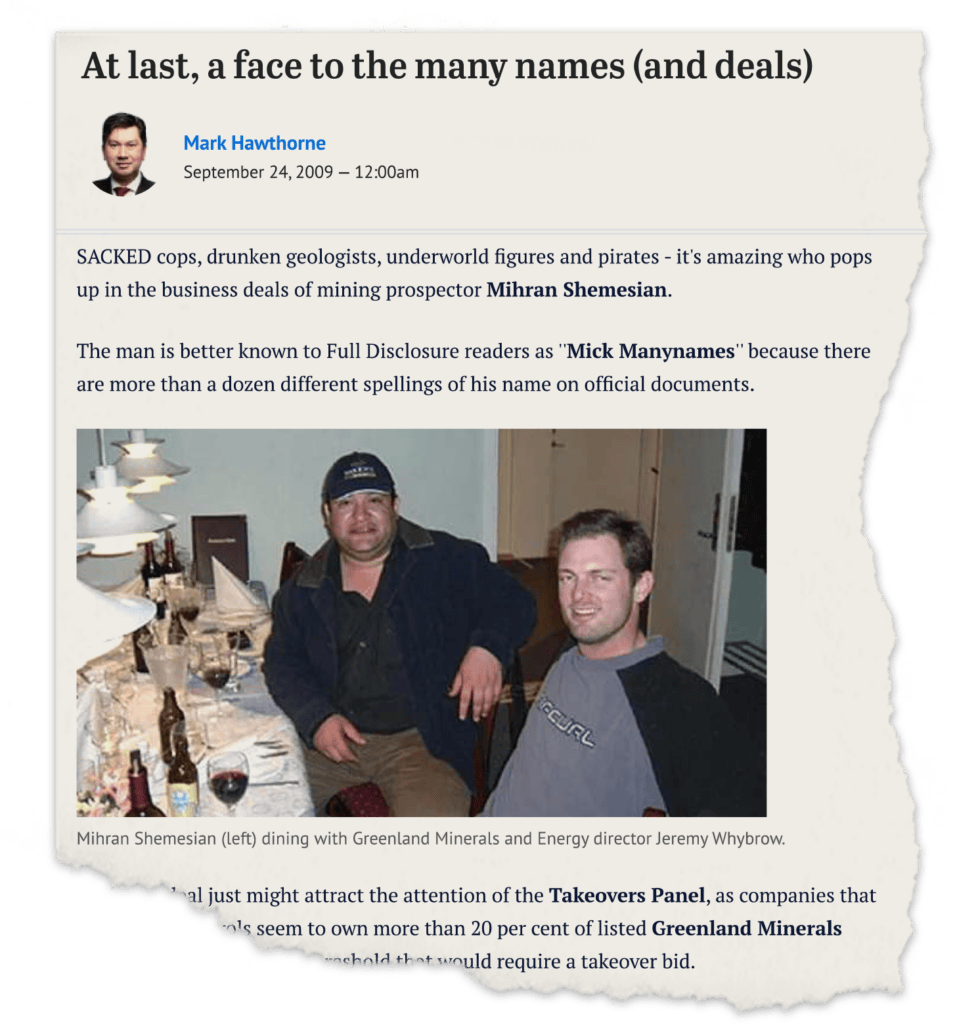

However, he hasn’t kept a completely low profile. The Sunday Morning Herald links Michael Shemesian to “fired police officers,” “drunken geologists,” “a central figure” in the Italian-Australian mafia, and pirates.
According to The Age, back in 2008 Michael Shemesian is said to have purchased oil rights in 2008 from militias in the Somali province of Puntland, which are suspected of controlling the pirates along the Somali coast.
In addition, the report describes how several of Shemesian’s many smaller companies have been involved in numerous legal disputes, primarily concerning ownership, control, and contracts in international mining and investment projects.
However, according to Danwatch’s information, he has never been convicted in any of them.

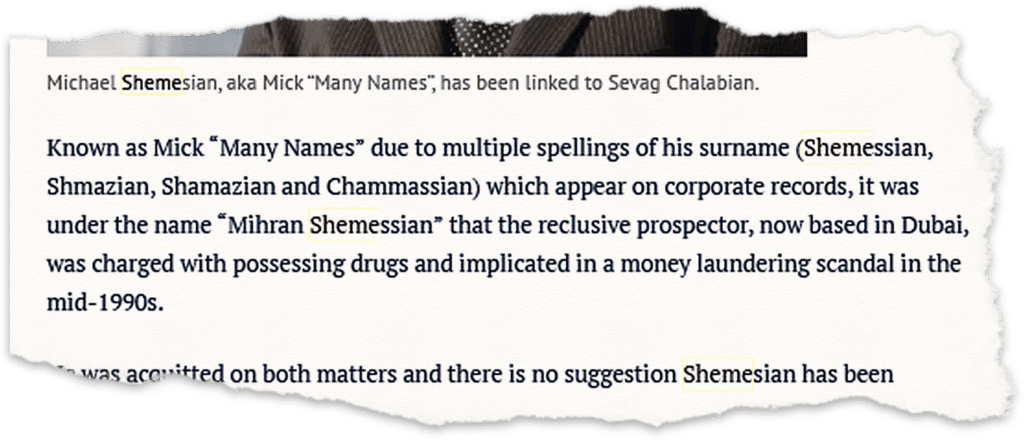
Especially between 2008 and 2017, Michael Shemesian’s many aliases appeared regularly in Australian newspapers.
But in recent years, he has largely disappeared from the radar.
At least in the media.
“You don’t see him, but he’s everywhere,” says Per Kalvig, who, in addition to being a geologist and former chief consultant at GEUS, has closely monitored mineral and raw-materials companies in Greenland for many years.
“He has had a hand in many companies,” he adds.
And that includes Greenland.
Here you can see the three licenses that Wally John Resources Greenland has been granted in Greenland.
Isle of Man, Jersey and Dubai
To determine Michael Shemesian’s role in Wally John Resources Greenland, Danwatch has reviewed company registers in Australia, Jersey and the Isle of Man.
These records show that the parent company, Wally John Resources Limited, was registered on the Isle of Man in 2021.
However, it was originally founded in Jersey in 2008 under the name Exchange Minerals, which, according to Bloomberg, Michael Shemesian founded and is the beneficial owner of.
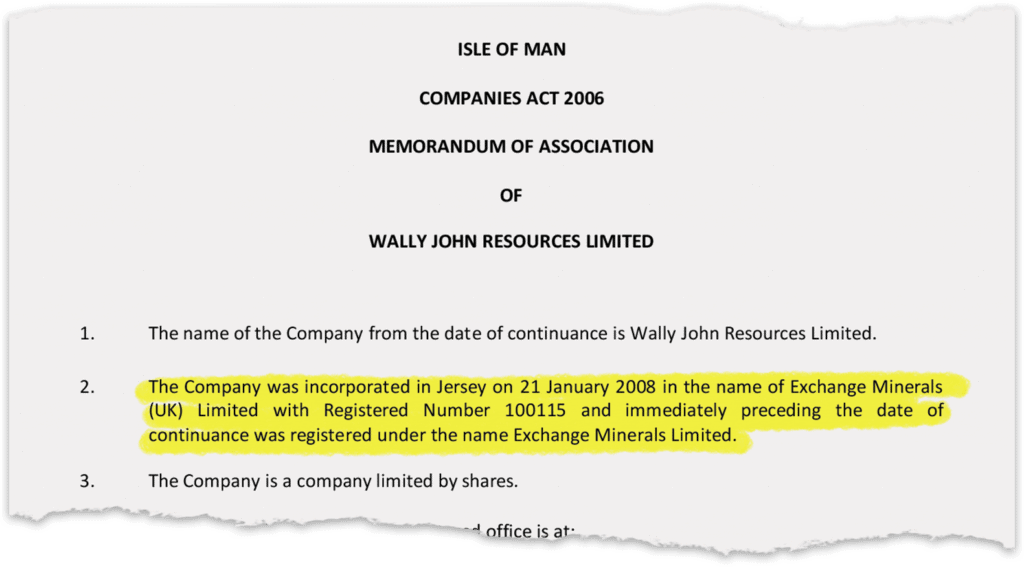
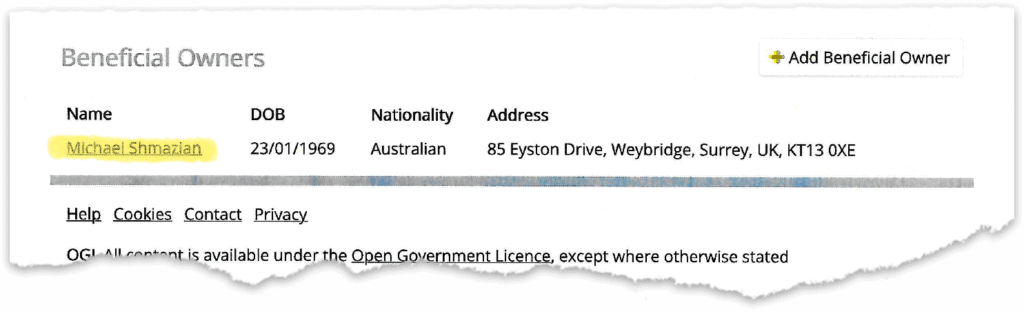
And it is indeed the company’s former name, Exchange Minerals, that Shemesian primarily uses today. But not in Greenland.
Exchange Minerals’ website states that the company has an office on the 41st floor of Emirates Towers in Dubai.
The website, however, is more or less devoid of details.
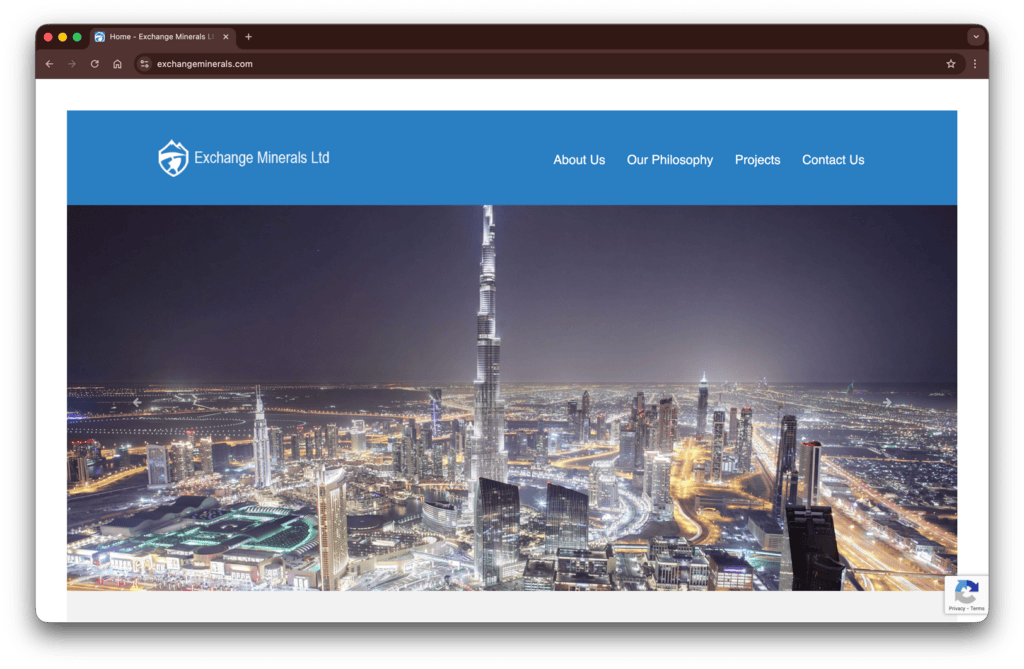
And that raises the second red flag for the experts:
“I always find it striking if the companies you’re dealing with only have addresses in countries with different tax regimes. That always makes me a little concerned. And the case officers in Greenland should be too. Because what’s actually behind this?” asks geologist and consultant Flemming Getreuer Christiansen.
Authorities were warned in 2013
A number of politicians and environmentalists posed the same question in an op-ed in Information in 2013.
They warned both the Danish and Greenlandic authorities about Michael Shemesian’s role in connection with the Australian mining company Greenland Minerals and Energy Limited (GMEL), which is behind what is probably Greenland’s most talked-about mining case, the Kvanefjeld project.
According to the op-ed writers and Australian media, Michael Shemesian was in fact the “founder” and “likely major shareholder” in GMEL. This was also the case at the time when the Chinese company Shenghe Resources Holding was invited to join, even though Denmark had warned against major Chinese investments in Greenland.
This photo is from 2012, when Greenland Minerals and Energy, in which Michael Shemesian was a shareholder at the time, was searching for rare soil types near the town of Narsaq in southern Greenland. Photo: Andrew Testa / Scanpix
Niels Henrik Hooge, a member of the environmental movement NOAH’s uranium group, is one of the six op-ed writers who called for an investigation of GMEL because of Michael Shemesian’s role.
He is surprised that Michael Shemesian’s name is now popping up once again:
“I must admit I am somewhat appalled. Because it shows that Shemesian—whom we have been warning about for 12 years—is still active,” he says, continuing:
“Kvanefjeld can be traced back to him from the very beginning, and that’s where the sale to the Chinese took place. It became a huge scandal after we had warned about it. And it could easily happen again if the Mineral Resources Authority isn’t able to exercise proper oversight.”
“Relatively simple requirements”
The Greenlandic Mineral Resources Authority is responsible for issuing licenses for Greenland’s subsoil, but when it comes to exploration licenses, the authority imposes “relatively simple requirements,” it states.
This primarily involves obtaining documentation of the applicant’s technical and financial capacity, the Mineral Resources Authority writes in an email to Danwatch.
In addition, a new Greenlandic requirement stipulates that licensees, management, and shareholders must not have been convicted of, among other things, bribery, fraud, terrorist acts, money laundering, or involvement in child trafficking or human trafficking.
According to the Mineral Resources Authority, however, “the depth of the background checks is limited” in connection with an exploration permit:
“One challenge may be that applicants are often part of international corporate structures, where a thorough review is required to clarify ownership, financing, and actual decision-making authority. (…). In addition, it can be a challenge to make assessments in an industry where companies are typically project companies without a long history,” writes the Mineral Resources Authority.
“A huge problem”
Nevertheless, the Greenlandic Mineral Resources Authority does not believe there is cause for concern, because “a more thorough assessment is conducted when deciding on exploitation licenses,” it writes. That is, when it is to grant the licenses that give companies exclusive rights to extract minerals or resources.
Among other things, external consultants are used to conduct the assessment.
But that is not enough, says consultant Flemming Gertreuer Christiansen:
“You simply have to look at who is granted the exploration licenses in the first place, because under Greenland’s mineral resources legislation the companies are entitled to an exploitation license if they find something. So if you cut corners there, you risk ending up in lawsuits like the Kvanefjeld case, and that is not good for Greenland,” he says, continuing:
“The head of department and the minister should instruct the case officers to immediately raise a red flag if privately owned companies from tax havens apply for exploration licenses.”
Security consultant Jacob Kaarsbo also believes that Greenland’s Mineral Resources Authority must tighten up immediately:
“We are in a situation where it is simply not good enough to just stamp a license and move on. It’s a huge problem if you don’t have enough resources to properly vet the companies’ owners,” he says.
The location of the licenses “looks odd”
The mere geographical location of the licenses in the specific case involving Michael Shemesian should set off alarm bells at the Mineral Resources Authority, according to Per Kalvig, former chief consultant at GEUS.
For not only do all the licenses cover the “heavyweight class” of minerals and raw materials, but geographically they are also located as far apart from each other as they possibly can be.
INTERACTIVE GRAPHICS
The distance and the lack of infrastructure make it almost impossible to complete exploration within the five-year term of the licenses, it is said:
“Mineral exploration is a massive undertaking, and when you dive into three vastly different geologies, as they have done—a significant portion of which belongs to the heavyweight class of the most difficult minerals—namely platinum and rare earth elements—then this is a rather peculiar way to go about it. It looks odd,” says Per Kalvig.
He describes mineral exploration as a kind of barter, where Greenland grants provisional rights to companies in exchange for important geological data. But in recent years, Per Kalvig has begun to worry about the intentions of several of the small companies in the exploration industry:
“I want to emphasize that I don’t want to single out the entire industry. There are indeed many serious small exploration companies,” Per Kalvig begins:
“But unfortunately, I’m starting to see a pattern where these strange little exploration companies pop up whenever there’s something involving critical raw materials or rare earth metals. Very enterprising investors obtain mineral licenses, after which they raise money for exploration of so-called critical raw materials based on very scant data—but they don’t carry out any serious programs. They are unscrupulous.”
Like Flemming Getreuer Christiansen, Per Kalvig calls for greater transparency regarding the basis for the Mineral Resources Authority decisions.
Among other things, he believes the geological work programs underlying the exploration permits should be publicly available.
But don’t we just have to trust that the Mineral Resources Authority has conducted a thorough assessment?
“I believe that when we have a case like this, which stands out so much, the benefit of the doubt should be given to us. Greater transparency, including better access to the geological programs that form the basis for the exploration, would also be something the exploration companies want,” he says.
Can revoke a license
The Mineral Resources Authority states in an email to Danwatch that it assesses that the current system, overall, ensures a high degree of transparency.
At the same time, it emphasizes that Naalakkersuisut (the Government of Greenland, ed.) can conduct ongoing investigations if they suspect that the requirements are not being met.
If that is the case, the authorities have the option to revoke the license. “In other words, requirements, control and consequences are built into the system,” it says.
Greenland officially assumed control of the mineral resources sector on January 1, 2010. This occurred in connection with the Self-Government Act, which gave Greenland the opportunity to take over responsibility for subsoil resources, including preliminary surveys, exploration, and exploitation. Prior to that, Denmark and Greenland shared decision-making authority. Photo: Andrew Testa / Scanpix
Regarding the claim that several small exploration companies are using the licenses as a commodity, the Mineral Resources Authority states that “it is difficult to use licenses as commodities,” and that “individuals who are convicted or charged with fraud or speculation may have their licenses revoked.”
Danwatch has attempted to obtain a comment from Michael Shemesian by contacting the law firm Nuna Law, which serves as the c/o address for Wally John Resources Greenland in Nuuk.
There, an employee offered to forward our inquiry to the director, but we never heard back.
We have also attempted to contact Michael Shemesian by sending an email to Exchange Minerals, and we have spoken with the receptionist at Exchange Minerals’ headquarters in Dubai, but Shemesian has not responded here either.
Finally, Danwatch has attempted to secure an interview with Naaja Nathanielsen, Greenland’s Minister of Industry, Minerals, and Energy, but she has not responded to our inquiries.