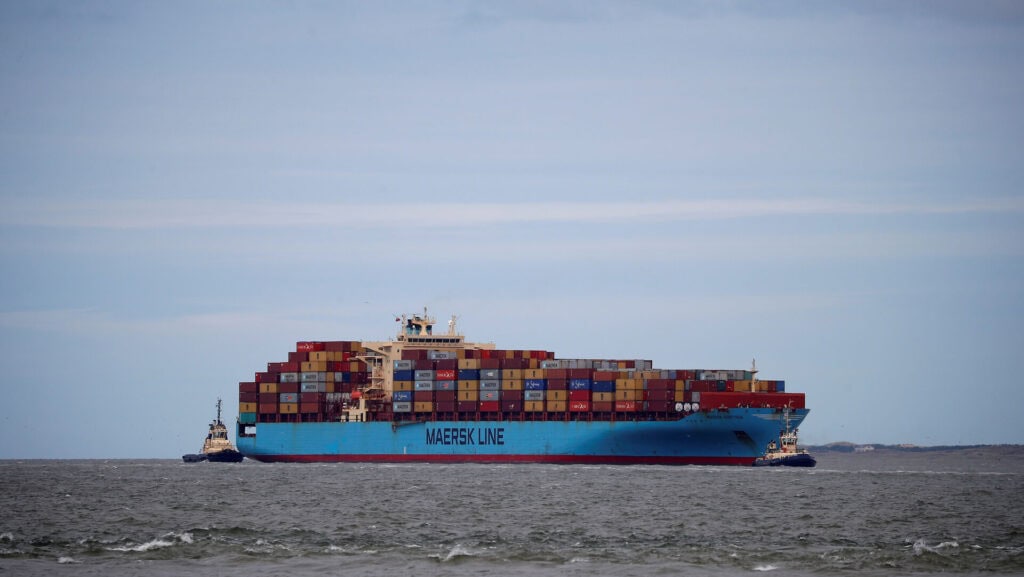
On 4 November 2023, the 299-metre long container ship Maersk Chicago will depart from the ports of New York and New Jersey, USA. The course is set for Haifa, Israel, where Maersk’s iconic blue colour will come into port a month later on the evening of 4 December.
The ship is loaded with seven shipments weighing 75.6 tonnes. This is according to bills of ladings obtained by Danwatch from the data company ImportGenius.
The shipments are categorised as ‘tanks and other armoured combat vehicles, motorised, whether or not armed, and parts of such vehicles’ according to the official US categorisation of goods.
However, a closer look at each bill of lading reveals that the packages are described as ‘HEMTT’ vehicles. HEMTT refers to the Heavy Expanded Mobility Tactical Truck military vehicle type produced by US defence manufacturer Oshkosh Defense. A vehicle sold to withstand ‘the harshest environments – both on and off the battlefield’.
https://oshkoshdefense.com/vehicles/heavy-tactical-vehicles/hemtt/
Four days after the cargo arrives in Haifa, an Oshkosh military vehicle is pictured in use 150 kilometres further south in Gaza. In the bed of the military vehicle, more than 30 Palestinian prisoners sit on top of each other, wearing only underwear, blindfolded and with their hands tied behind their backs.
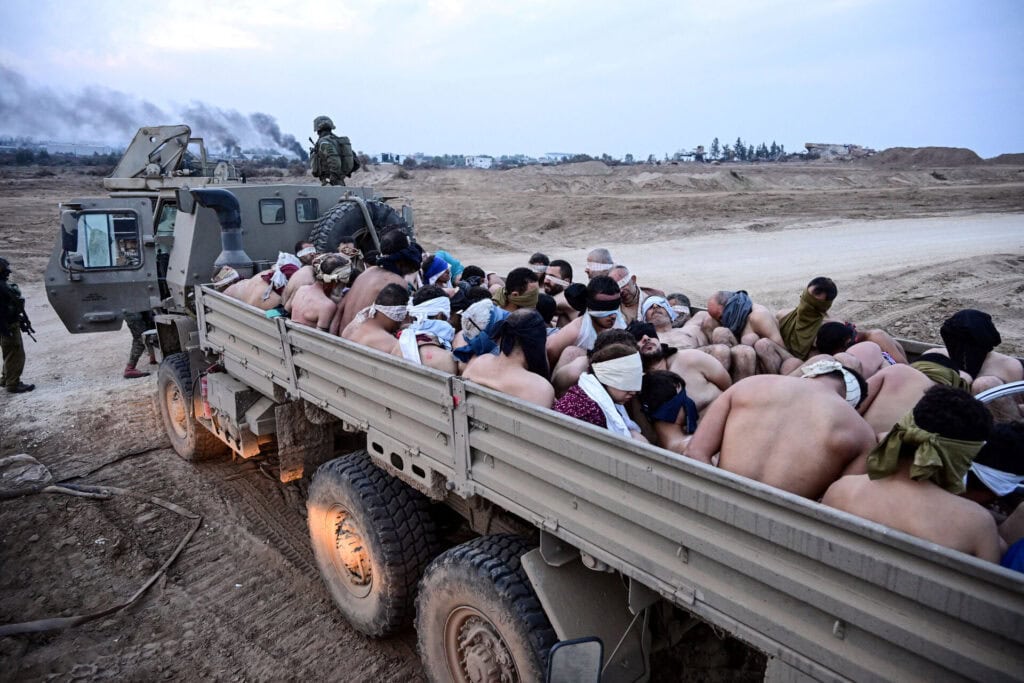
Photo: Yossi Zeliger/Reuters/Ritzau Scanpix.
The photo, which caused a huge stir in the aftermath, was taken just before the captured Palestinians were transported to Israel, where they were subjected to violent interrogation by Israeli soldiers. Several of the detainees are civilians.
Danwatch has gained insight into more than 2,000 consignment notes of shipments from the US to Israel between September 2023 and September 2024, showing that at least 453 packages of Oshkosh Defense sub-components were transported to the Israeli government under the Maersk logo.
But Oshkosh vehicles are just a small part of the military hardware that Maersk has transported to Israel in the period following the brutal Hamas-led attack on Israel and Israel’s massive assault on Gaza after October 2023.
43 times, 14 different Maersk-owned container ships have transported thousands of tons of military equipment during the first year of the war. Military equipment such as sub-components for armored personnel carriers, combat vehicles, missile casings and other goods for military use.
Freight comes into use
Where the cargo on Maersk container ships ends up after after being shipped to Israel is not known for sure.
According to Alexander Tetzlaff, military analyst at the Centre for Military Studies at UCPH, it cannot be ruled out that some of the cargo will end up in Gaza.
“It’s reasonable to think that some of the military hardware is being used in Gaza,” says the military analyst.
FACTS
See what’s in the cargo
Note: Each shipment can contain multiple packages. For example, 78 packages of military hardware were transported in one shipment on 30 July 2024 on the ship Maersk Seletar.
Peter Viggo Jakobsen, Associate Professor at the Department of Strategy at the Royal Danish Defense College, has similar thoughts.
“There is a high probability that some of the cargo will end up being used in the war in Gaza,” says Peter Viggo Jakobsen.
“The Americans know that it is used for war, and therefore also in Gaza.”
Since October 2023, both the military wing of Hamas and Israel have been accused of war crimes. Since then, the International Criminal Court (ICC) has issued an arrest warrant for Israeli Prime Minister Benjamin Netanyahu and Defense Minister Yoav Gallant, as well as three Hamas leaders suspected of war crimes and war crimes against humanity.
The UN has concluded that Israel has committed war crimes, crimes against humanity and violated international law. And in May 2024, the International Court of Justice (ICJ) issued an injunction ordering Israel to immediately cease its military offensive in Gaza in connection with a lawsuit in which South Africa has accused Israel of committing genocide.
Meanwhile, Maersk continued shipping weapons parts to Israel.
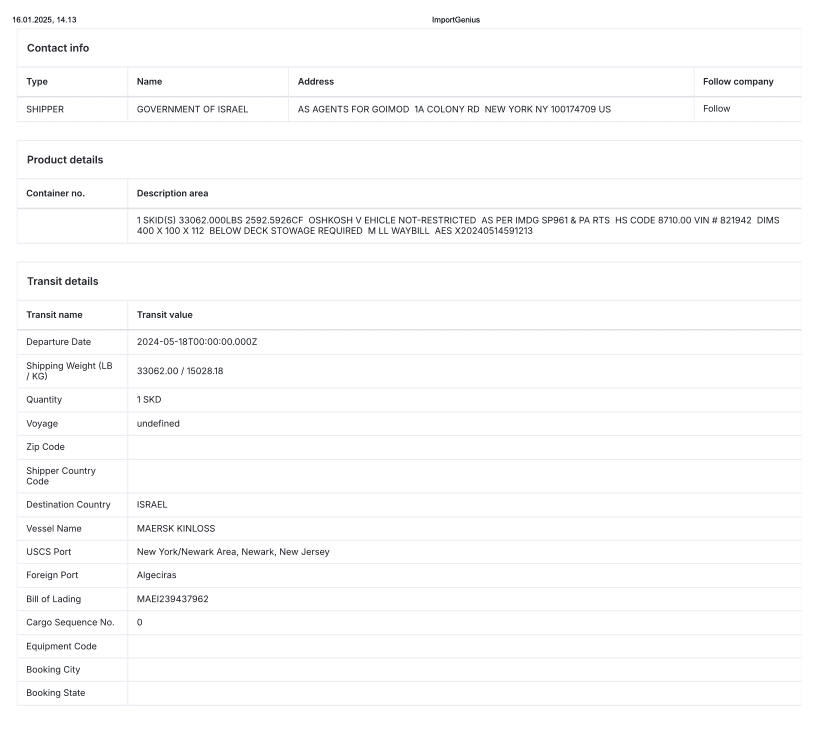
DOCUMENTATION
Consignment note with military hardware
Here is an example of one of the consigment notes that Danwatch has been given access to. The bill of lading documents that Maersk has transported tanks and other armored military vehicles – or sub-components thereof – from the Oshkosh Corporation.
Maersk has an ethical responsibility
In Denmark, there is no law that prevents Danish companies from transporting weapons to a country that commits war crimes. Nor do the EU or UN arms trade agreements cover companies, explains Peter Vedel Kessing, Senior Researcher at the Danish Institute for Human Rights.
“It’s the country from which the export takes place that is responsible,” says the senior researcher.
Thus, if the weapons are transported from the US, it is the American state that is responsible for complying with any treaties. However, as the US is not a signatory to the UN Arms Trade Treaty, they are not subject to these obligations.
“What Maersk is doing is – in a nutshell – just transporting it to and from the countries. The authorisation must be obtained from the country where the military equipment is located,” says Peter Vedel Kessing.
Zeray Yihdego, Professor of International Law at the University of Aberdeen and one of Europe’s leading experts on arms control law, points instead to Maersk’s ethical responsibility.
“Companies have a duty to respect human rights when operating outside the territory of their state,” says Zeray Yihdego, emphasizing that Maersk and the Danish state have a responsibility to ensure that there is no contribution to human rights violations.
If you read Maersk’s latest Code of Conduct from 2023, the company states that they have implemented the UN Guiding Principles on Business and Human Rights.
This means, among other things, that Maersk has a responsibility to avoid ‘adverse impacts’ on human rights and to address such impacts. This is stated in the UN Guiding Principles on Business and Human Rights
Thus, the shipping giant has a responsibility to ensure that the weapons parts are not used to violate human rights.
But how can it be ensured that Maersk lives up to its ethical obligations?
The giant is silent
According to Sune Skadegaard Thorsen, expert in responsible corporate behavior and owner of the consultancy Global CSR, it all boils down to whether Maersk has conducted a so-called human rights due diligence of the activity in question.
“This is the only way to hold Maersk accountable,” says the expert in responsible corporate behavior, who also points out that this responsibility applies to all companies.
A human rights due diligence process must document that the company regularly ‘identifies risks of adverse human rights impacts, describes what the company is doing to prevent or mitigate them, and measures the effectiveness of its efforts’. This is stated in the UN Guiding Principles on Business and Human Rights, to which Maersk is committed.
We wanted to ask Maersk about that:
Danwatch has contacted Maersk to get answers to the following questions:
- Can you guarantee that none of the military hardware transported to Israel is used in the war in Gaza? How do you ensure this?
- Have you conducted a human rights due diligence report on these activities?
- What are your thoughts on the fact that the weapons you have sent to Israel risk being used to commit war crimes in Gaza – in relation to the UN Guiding Principles on Business and Human Rights and international law?
Maersk has been presented with the 43 shipments of military hardware and were asked if they can guarantee that the cargo will not be used to commit war crimes in Gaza.
Maersk’s press officer, Jesper Lov, has not responded to the numerous inquiries. Subsequently, Danwatch has reached out to others in the press department.
“We do not wish to comment,” says Povl Rasmussen, who is responsible for matters relating to ‘ocean business’.
Nor has Maersk prsented any due diligence report.
And that can only mean one thing, says Sune Skadegaard Thorsen.
“If Maersk cannot provide evidence that they have conducted a human rights due diligence, the company is not in compliance with the UN Guiding Principles,” says the expert in responsible corporate behaviour.
“This indicates that Maersk does not respect human rights,” he says.
Danwatch has also presented the case to the Ministry of Foreign Affairs to hear what they have to say.
They state that “Danish companies must of course comply with all international rules and that the authorities continuously monitor that this is happening”. What companies should do beyond that, “we cannot dictate”, according to the ministry.
Danwatch has also tried to contact the Israeli Ministry of Defense to find out what the cargo of military hardware has been used for. They have not responded.