

For years, experts have speculated about the most effective weapon in the Western fight against Russia’s infamous dark fleet.
Shady tankers, surrounded by mysterious ownership, dubious certificates and invalid insurance.
In response to the dark fleet, there is currently an abundant amount of NATO ships, sailing around in the Baltic Sea, monitoring the ships’ movements and the Russians in general, just as all sorts of controls have been introduced in the Gulf of Finland and the Kattegat to stop the fraud with papers.
However, that doesn’t seem to work, either. The authorities have been deceived by fake papers all over again, as documented by Danwatch, by the way, and it is notoriously difficult to do anything about it.
Just as a ship must have insurance, a flag state and other measures, which protect coastal states against accidents and environmental disasters, the authorities must have an incredibly good reason to stop merchant ships from sailing freely in international waters.
Therefore, one can currently only ask politely whether or not they will submit this information voluntarily. If they don’t, they risk being sanctioned.
Despite patrolling NATO ships and 18 different sanctions packages, the result is that the dark fleet still sails around in the Baltic Sea with Russia’s precious oil.
Although many different things have been pulled out of the EU’s large, bureaucratic toolbox in an attempt to stop this dark fleet, it has been with very mixed results.
One of the toolbox’s most hard-hitting tools is the hammer, meaning the historically harsh sanctions against Russia and especially the country’s oil exports to punish them economically.
Many of these sanctions are targeted at the dark fleet. However, new figures show that not even they can stop the ships entirely.
Clear effect, but how big?
All ships have a unique registration number attached, and the ship has that exact number for its entire lifetime, regardless of how many times it is sold or changes its name and flag.
If a ship is sanctioned, it risks becoming a kind of persona non grata at sea or, in this case, nave non grata.
There have been examples of a ship being sanctioned by either the United Kingdom, the EU or the USA and suddenly standing still for weeks. But a brand new analysis shows that it is probably not quite as effective as first assumed.
In a recently published research article, Assistant Professor, Yevgeniy Golovchenko, from the University of Copenhagen’s Department of Political Science attempted to map the effect of the sanctions. In short, the sanctions affect the ships’ ability to continue sailing with Russian oil to a relatively large extent; however, they still continue sailing, though experiencing some difficulties.
Depending on who is looking, the result of the analysis is either very encouraging or depressing. The ships call at port even less, sail shorter routes and make fewer controversial cargo transfers at sea.
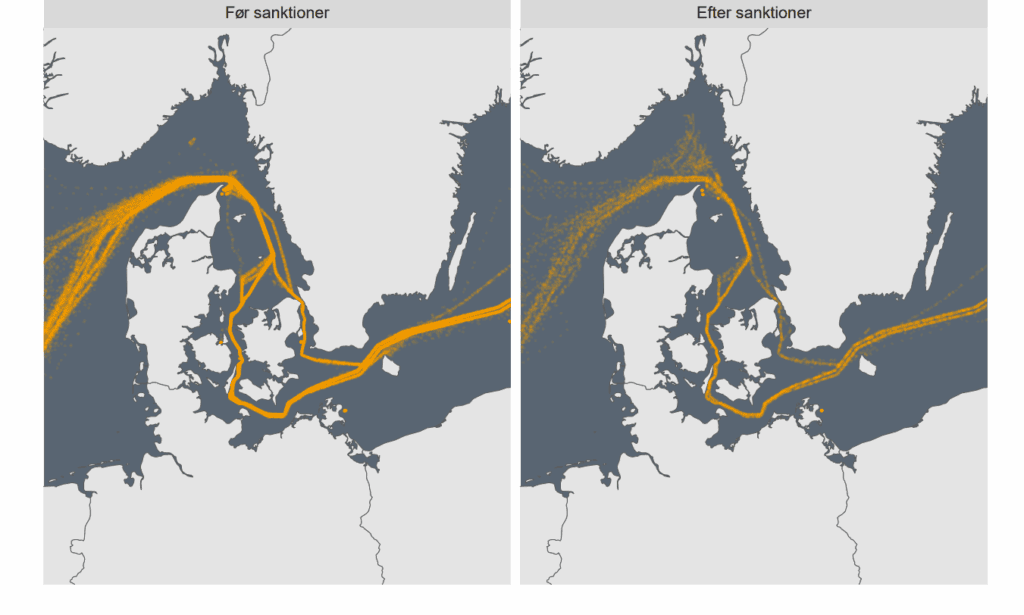
The man behind the study, Yevgeniy Golovchenko, informs Danwatch that these figures show that the, “targeted sanctions actually work in relation to reducing” the ships’ routes, port calls and cargo transfers.
Nevertheless, the figures also show that the sanctioned part of the dark fleet, “continues to sail to a certain extent, even though their activity has been enormously reduced”, Golovchenko points out.
If the aim is to stop the dark fleet entirely, one must also face the fact in light of these figures that further measures are required than these sanctions, which have been adopted so far.
On the other hand, Denmark took over the EU presidency in July, and there has been much pressure from the Danish side to introduce more sanctions against Russia and the dark fleet in particular.
Therefore, you can easily expect that the latest sanctions package will not be the last one.
Fact Headline (H2)
- In the study, Yevgeniy Golovchenko compared these sanctioned oil ships with a control group of other oil ships in order to see how their behavior changes. The main points are:
- Sanctioned ships call at port 53 percent less, which indicates that it is more difficult to find a port to dock at.
- Ships sail an average of 83.6 percent shorter distances after they have been sanctioned.
- There is also a marked decrease in the controversial STS transfers (ship-to-ship). After the sanctions, 36.5 percent fewer STS’s are being registered.
- There is no difference in the number of so-called blackout events or ‘dark events’ where the ships turn off their transponder and hide their location.
New drones spy on the spies
In addition to the sanctions, the toolbox has been filled with a lot of things which can best be described as a handful of different Swiss army knives.
Some different instruments, which must counteract the hybrid part of the fight against the dark fleet, which is gradually approaching a very hot point.
It is no longer just about shady oil ships without proper papers.
Reports of cameras, espionage equipment and uniformed personnel on board the ships have increased and, in some cases, it appears as if Russia is using naval ships to scare NATO away when the worst of the worst tankers sail through the Baltic Sea. Here, we are talking about the ships that give false information about being legally registered in a number of countries, which do not have any ship registered at all.
The ships are being called stateless and are one of the biggest challenges for the NATO countries in the Baltic Sea at the moment. Many Baltic Sea countries wish to take a tough standing point against the dark fleet and especially these stateless ships; however, when Estonia tried to do just that and stop the ship Jaguar back in May, they were met by a Russian fighter jet, which scared the Estonians away, even in Estonia’s own airspace.
The whole scene was even filmed and shared by the crew on board the stateless tanker. A week and a half after this tense episode, Jaguar left Russian waters anew and sailed completely undisturbed past Estonia, Finland, Sweden, Germany and Denmark. Whether this was due to the Russians’ aggressive behavior is difficult to say, nevertheless at least conspicuous.
There is absolutely no doubt that the West’s fight against the dark fleet is something that Russia takes very seriously and is willing to go to great lengths to fight. Among other things, Russia accused the United Kingdom of planning sabotage operations against tankers from the dark fleet.
The conflict is also seen at home in Denmark where heavily equipped research ships and tugboats from Russia’s fleet sail around and exhibit patrolling behavior.
Therefore, Denmark also invested in two new sea drones with a large sail on, the so-called “saildrones”, which will monitor and protect the proud Danish waters.
Although I now doubt that it is sufficient to scare Russia away when you consider that the Estonian coast guard was pushed back by Russian fighter jets, the Danish Defence has certainly not hesitated to use them.
When the military tugboat, Aleksandr Frolov, sailed around in the Baltic Sea area south of Møn and Langeland for almost ten days, it was, according to ship data from MarineTraffic, probably closely observed by one of the two saildrones.
The Danish Defence did not wish to confirm to Danwatch that is has been keeping an eye on the Russians but write in an email that it is carrying out, “an operational test of unmanned, sailing units from the American company Saildrone”.
If the test is passed, it may well be that we have to get used to more sea drones in Danish waters.