Part of an investigation
This article is a part of the investigation The Shadow Fleet
- According to experts and politicians, the Russian shadow fleet is Russia's response to Western sanctions. Ships transport oil from Russia without Western authorities being able to monitor what's happening. This way, the oil can be sold for more than what the sanction-imposed price cap allows.
- The shadow fleet consists mainly of older tankers that have been purchased over the past two years by companies that are difficult to scrutinize. They almost exclusively transport Russian oil and are registered in countries outside the EU and G7 nations.
- The ships typically have opaque ownership structures and unknown, questionable, or non-Western insurance, such as Russian insurance companies. This has led to British and American sanctions specifically naming several Russian insurance companies.
- The ships often sail under flags of countries with less oversight, such as Cameroon or the military dictatorship of Gabon in Africa, but they can also operate under flags of countries like Panama, Liberia, Vietnam, and others. The ships frequently change names and flags because they often change owners. According to experts, this is done to obscure the trail to the actual owners.
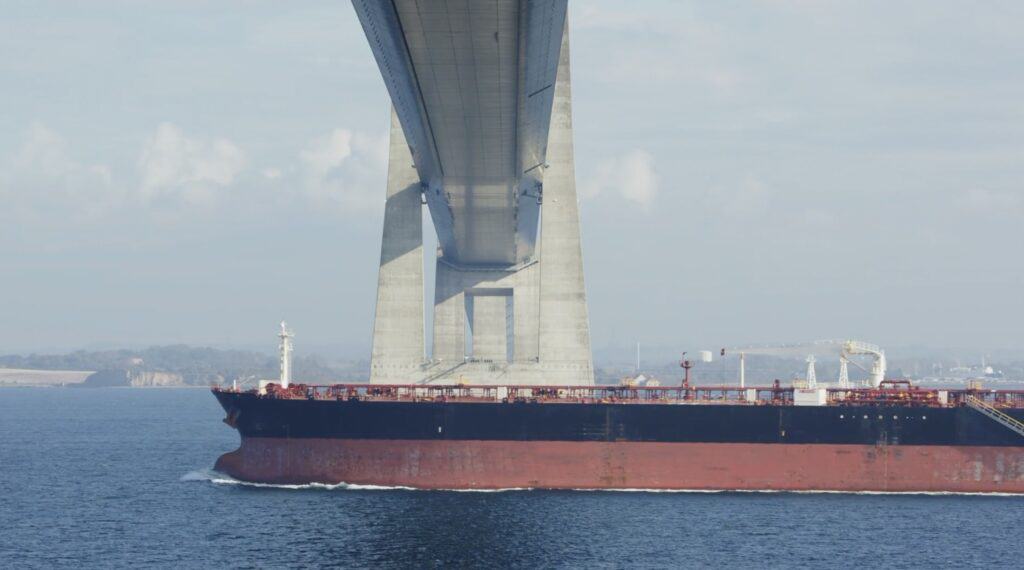
- These large tankers sail through Denmark and the Great Belt daily, as it's the only route out for fully loaded tankers coming from the major Russian oil ports around St. Petersburg.
- Government leaders like Prime Minister Mette Frederiksen have identified the shadow fleet as a major concern and a problem that the West must address. Therefore, NATO ships have been deployed in the Baltic Sea to monitor and protect the area from oil disasters and sabotage of undersea cables.
- Sources: Lloyd's List Intelligence, CREA, Kyiv School of Economics, OFSI, OFAC
It almost seemed as if the man in the camouflage uniform wanted to be seen.
It was midday in summer, and he was standing at the front of the deck during the passage through Øresund. He had a phone in his hands, which he used to take pictures, though it’s unknown of what.
He and another Russian man were aboard a tanker that officially had no connection to Russia except for transporting oil from the Gulf of Finland. But in reality, the ship was part of the dark fleet.
According to the crew papers, which Danwatch has obtained, the men had no official function on the ship. They are simply described as ‘extra crew’ without further clarification.
Danwatch can now reveal that one of the men is a former leader of a Spetsnaz unit in Kaliningrad. This is evident from data from a leaked Russian government database that Danwatch has obtained through sources in Russia.

His unit was a military special forces unit under the Kaliningrad customs and border police, consisting of two combat units specializing in diving, among other things. He headed the unit until 2009, after which, according to the data, he has no official work history.
Danish pilots from the state pilotage service DanPilot are increasingly encountering these mysterious little green men when they are aboard dark fleet ships.
According to Jacob Kaarsbo, former chief analyst at the Danish Defence Intelligence Service and now an independent security analyst, this revelation shows that Russia is using civilian ships in the conflict with NATO.
“It emphasizes that the dark fleet is being used for military purposes. Regardless of whether the person is still in the military system itself or in a private army, it is ultimately controlled by the intelligence service, GRU,” he says.
The ship has sailed through Denmark four times since July, when the man and his Russian companion were observed aboard. It is not known whether they are still aboard the ship.
Jacob Kaarsbo calls for more direct action from NATO:
“You should ensure that all paperwork, registration documents, and insurance papers are in order and that there are no military personnel on board. There should be a joint NATO operation using the navy to intervene forcefully.”
Increased Threat to Denmark
GRU is Russia’s notorious military intelligence service, suspected of being behind numerous sabotage operations and murders in the West.
Most recently, on December 4, a large number of people with ties to GRU were sanctioned by the UK for the assassination of Dawn Sturgess back in 2018. Sturgess was poisoned with Novichok, a special neurotoxin developed by Russia, which the Russian intelligence service is known to use.
If GRU is operating in Danish waters, it means that “the threat to Denmark has increased,” says Jacob Kaarsbo.
“We know how the Russians operate, and they use all kinds of unconventional means to attack their enemies. There is a high risk that these dark fleet ships will be used for that purpose,” he says.
The Danish Defence Intelligence Service’s (FE) latest risk assessment for 2024 states that Russia poses an increased threat to NATO countries and that tension levels will increase if the dark fleet receives Russian naval escort, for example.
And in recent months, Russia has begun to draw a closer parallel between Russia and the dark fleet, which otherwise tries to appear as un-Russian as possible to the outside world.
Because as the West has tightened its grip on the ships, Russia has increasingly begun to use its military to defend the dark fleet.
For example, on September 19, three Russian fighter violated Estonian airspace for 12 minutes to force the Estonian coast guard away when the Estonians tried to stop a dark fleet ship.
The dark fleet ship escaped and sailed safely into port in Russia, and the crew filmed the entire remarkable incident and shared it on social media.
“Research Ships” and Dark Fleet
According to Jacob Kaarsbo, this all shows that the dark fleet has become more directly linked to Russia’s military operations.
“We have previously seen the Russians use so-called research ships with uniformed personnel aboard. They have used them to map underwater infrastructure and to assess NATO’s response patterns and the like. So it’s natural to think that expanding the operation with the dark fleet may have an intelligence element from the Russians,” he says.
The FE report further states that military escort can lead to increased tension levels, as was seen in Estonia.
The latest example of how violent things can get when the dark fleet becomes involved in the war is in the Black Sea.

Here, Ukraine has attacked two dark fleet tankers with sea drones off the Turkish coast.
Dramatic images from the attack show large explosions near the ship’s rudder, and from inside, the crew can be seen evacuating in panic.
Despite increased tensions in the Baltic Sea, however, it is not realistic that we will see drone attacks on tankers close to Danish borders, Jacob Kaarsbo assesses.
“It’s impossible to say what this means for our latitudes, but there’s a hot war going on in the Black Sea, which is not the case here. Maybe Russia will defend the ships a bit more, but I don’t think it will have a major impact,” he says.
The ship with the former Spetsnaz leader is currently in the Mediterranean heading towards Russia via Denmark.
Danwatch has repeatedly attempted to obtain comments from various authorities regarding the uniformed Russians on civilian ships. While the ministries have remained silent, the Defence Command has previously responded that they are not aware of Russian soldiers on civilian ships in Danish straits.
The reason given is that it cannot be said with certainty that they have any connection to the military. However, the Defence Command will neither confirm nor deny that uniformed Russian men are sailing on civilian ships.
However, the Danish Defence has not wished to comment on the new information now being reported by Danwatch. The Ministry of Foreign Affairs of Denmark does not wish to comment on the matter specifically, but states:
“In general, it can be stated that the Ministry of Foreign Affairs and other Danish authorities continuously exchange information with our foreign partners, just as we work together with other countries on this challenge in relevant regional and international forums.”