Part of an investigation
This article is a part of the investigation The Shadow Fleet
- According to experts and politicians, the Russian shadow fleet is Russia's response to Western sanctions. Ships transport oil from Russia without Western authorities being able to monitor what's happening. This way, the oil can be sold for more than what the sanction-imposed price cap allows.
- The shadow fleet consists mainly of older tankers that have been purchased over the past two years by companies that are difficult to scrutinize. They almost exclusively transport Russian oil and are registered in countries outside the EU and G7 nations.
- The ships typically have opaque ownership structures and unknown, questionable, or non-Western insurance, such as Russian insurance companies. This has led to British and American sanctions specifically naming several Russian insurance companies.
- The ships often sail under flags of countries with less oversight, such as Cameroon or the military dictatorship of Gabon in Africa, but they can also operate under flags of countries like Panama, Liberia, Vietnam, and others. The ships frequently change names and flags because they often change owners. According to experts, this is done to obscure the trail to the actual owners.
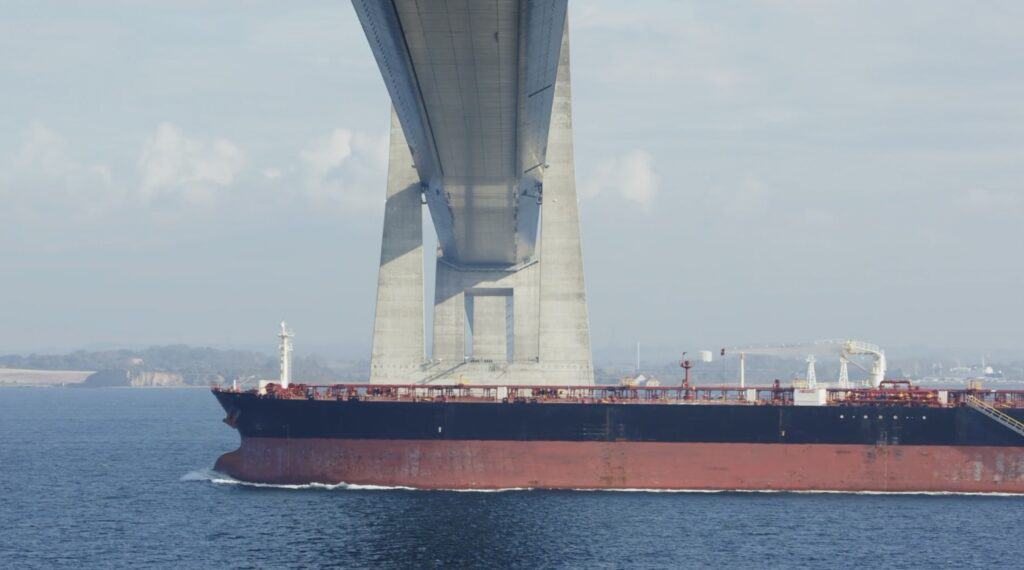
- These large tankers sail through Denmark and the Great Belt daily, as it's the only route out for fully loaded tankers coming from the major Russian oil ports around St. Petersburg.
- Government leaders like Prime Minister Mette Frederiksen have identified the shadow fleet as a major concern and a problem that the West must address. Therefore, NATO ships have been deployed in the Baltic Sea to monitor and protect the area from oil disasters and sabotage of undersea cables.
- Sources: Lloyd's List Intelligence, CREA, Kyiv School of Economics, OFSI, OFAC
The Russian shadow fleet not only earns billions of kroner for Putin’s war machine by transporting sanctioned oil around the world.
It is also actively participating in spying on critical infrastructure in Denmark. This is revealed in the internal correspondence from the state-owned pilotage company DanPilot, which Danwatch has obtained.
In a group email from earlier in July with the heading “Militant types on the bridge”, it states:
“There are increasingly more reports of ships that have a couple of extra crew members, who are presumably Russian, who are wearing military uniforms on the bridge and very active in photographing bridge passages, among other things.
“All these reports are of course forwarded to the authorities,” the email states.
The warning comes after an incident a few days earlier where a picture was taken of a man in uniform, filming from a sanctioned ship from the shadow fleet.
Security Policy Advisor, Jakob Kaarsbo, who has a background as chief analyst in
the Danish Defence Intelligence Service, is not surprised by Russia’s new initiative.
“It seems as if Russia has begun to use the shadow fleet as a form of hybrid deployment, and the fact that they are especially active when sailing past Danish strategic installations and critical infrastructure is unfortunately not surprising.”
“It is well-documented how Russia previously used so-called research vessels for military purposes to map underwater infrastructure,” he says.
Sabotage Actions
According to analyses from i.a. Lloyd’s List Intelligence, the Russian shadow fleet consists of over 700 tankers, of which 444 are currently sanctioned by the EU. They pass through Denmark and the Great Belt almost daily because it is the only way out when they come from the large Russian oil ports around St. Petersburg.
Naval Captain and Military Analyst, Jens Wenzel Kristoffersen, does not see this as a threat in itself that pictures of critical infrastructure are being taken from ships in the shadow fleet.
“These are probably already extensively photographed. Instead, it could be about keeping the Russian Intelligence Service updated on any changes to the critical infrastructure by photographing these during passage, so that they always possess the latest information regarding potential sabotage actions, which must be anticipated as already planned,” he says.
Danwatch presented the material to the Ministry of Security and Preparedness, which refers to the Danish Emergency Management Agency. The agency refers to the fact that pilots, according to the Danish Pilotage Act, must report to the relevant authority as regards conditions observed, which are significant for navigation safety, environment or other societal considerations.
“Thus, DanPilot, like other pilotage services, must report all relevant conditions to the Danish Emergency Management Agency. Beyond this, the Danish Emergency Management Agency cannot comment further on DanPilot’s observations,” writes the Danish Emergency Management Agency.
Requires Action
Additionally, Danwatch asked the Danish Emergency Management Agency if Denmark will react to these observations:
“Nationally, there are ongoing cooperations across relevant authorities on coordinating measures against the shadow fleet. In addition, the authorities continue to enhance the maritime situation around Danish waters.”
“Internationally, Danish authorities also collaborate on the challenge with other countries in relevant regional and international forums, just as the Danish Emergency Management Agency is in continuous dialogue with our partners. Additionally, Denmark acquired a group of the most affected regional countries, which meet regularly at the expert level to exchange information and work for further international measures against the shadow fleet,” continues the response from the Danish Emergency Management Agency.
Jakob Kaarsbo, however, doesn’t think much of this lack of action behind the international initiatives.
“Russia exploits our respect for international treaties to potentially undermine our security. And we need to dare to act and look at how we specifically can stop these acts.
“When we fail to put a stop to things, Russia pushes the boundaries further. We see this now with the blatant espionage from the shadow fleet. Russia is not afraid of reprisals because they perceive us as being weak, who don’t dare to do anything anyway,” he adds.
Difficult to Stop
There have not yet been examples in Denmark of ships from the shadow fleet being stopped, and Jens Wenzel Kristoffersen points out that it can be difficult to stop them:
“Being able to do something about it from the authorities’ side in the region requires a joint effort and approach from all the countries around the Baltic Sea. Also, there needs to be agreements on which measures to implement.”
“If ships comply with all navigation requirements, including taking a pilot on board and merely making innocent passage, there is not much to do. It is only if there is suspicion of law violations or drug smuggling that the ship is not considered seaworthy, etc., and that there is legal authority to do something”, he says.
Among other things, the EU’s current sanctions against 444 ships from the shadow fleet include that they do not have access to ports in Denmark and the rest of the EU, just as they may not receive any services.
Danwatch has previously written about how a sanctioned and stateless ship from the shadow fleet with 100,000 tons of oil on board deceived the Danish authorities. You can read about this here.